Emergency Dentist Plano, TX: Signs of a Serious Dental Infection


A toothache can be easy to dismiss at first. People put it down to a cracked filling, sinus pressure, grinding at night, or something cold that hit a sensitive spot. Then the pain shifts. It deepens, throbs, wakes you up, spreads into the jaw, or makes it hard to chew. At that point, the question is no longer whether something is wrong. The question is whether the problem has crossed into emergency territory.
A serious dental infection is not just a bad toothache. It is a bacterial problem that can move from the tooth into the surrounding gum, bone, and soft tissues of the face. In some cases, it can affect swallowing, breathing, and overall health. That is why people searching for an emergency dentist Plano, TX are often doing so under pressure, when pain is no longer manageable and swelling is becoming visible.
The hard part is that dental infections do not all look dramatic in the beginning. Some start with vague tenderness. Others announce themselves all at once. Knowing the warning signs can help you act before a treatable infection becomes a hospital-level problem.
Why dental infections become emergencies
Most serious dental infections begin with a pathway for bacteria to get inside the tooth or beneath the gumline. Deep decay is one common route. A cracked tooth is another. Advanced gum disease can create pockets where bacteria multiply. Wisdom teeth can also trap debris and inflame the surrounding tissue, especially when they only partially erupt.
Once bacteria reach the pulp of the tooth, where the nerves and blood vessels live, the body mounts an inflammatory response. Pressure builds inside the tooth, and that is often when the classic throbbing pain starts. If the infection escapes beyond the root tip, it can form an abscess. An abscess is essentially a pocket of infection, but that simple description does not capture how aggressive it can become. The mouth and face contain many connected spaces, and infection does not always stay put.
What makes this especially tricky in practice is that pain and danger do not always rise in perfect sync. Some patients have severe pain from a problem that remains localized. Others have surprisingly little pain after a tooth nerve dies, even while the infection continues spreading. That mismatch is one reason dentists pay close attention to swelling, fever, drainage, and changes in function, not just the pain score.
The pain that should get your attention
Not every toothache is an emergency, but certain pain patterns deserve urgent evaluation. A fleeting zing from ice water can point to sensitivity or a minor cavity. Constant, deep, pulsating pain is more concerning. Pain that worsens when you lie down, pain that radiates to the ear or temple, or pain that makes it difficult to focus at work often reflects pressure and inflammation that have gone beyond simple sensitivity.
Another red flag is pain with biting, especially if the tooth feels taller than the others or seems to hit first when you close your mouth. Patients sometimes describe it as a bruised feeling in the tooth. That can happen when inflammation around the root builds enough pressure to slightly lift the tooth in its socket. It is not a diagnosis by itself, but when it appears with swelling or lingering hot sensitivity, infection moves higher on the list of possibilities.
There is also the kind of pain that seems to vanish suddenly after days of intense symptoms. Many people take this as good news and postpone care. Clinically, that is not always reassuring. A dying pulp can stop transmitting pain the way it did before, but the bacteria can remain active. If the face starts to swell after the pain eases, that is not recovery. It is escalation.
Swelling changes the picture
Facial or gum swelling is one of the clearest signs that a dental infection may be serious. A pimple-like bump on the gum near a painful tooth can indicate a draining abscess. Sometimes that bump comes and goes. Patients say it tastes salty or foul when it pops. While drainage may temporarily reduce pressure, the infection source is still present.
Swelling in the cheek, jawline, or under the eye deserves faster attention. It means the infection is no longer confined to the inside of the tooth. Swelling under the jaw or in the floor of the mouth is more concerning still, because that area relates to the spaces that can affect swallowing and breathing. If someone cannot open fully, has trouble swallowing saliva, or feels that the tongue is being pushed upward, emergency medical care is appropriate.
One pattern seen in real practice is the patient who wakes up with a face that looks visibly different than it Emergency dentist Plano, TX did the night before. They often say the pain started a few days earlier but became less sharp just before the swelling appeared. That sequence is classic for an infection that has found a way out of the tooth and into surrounding tissue.
Fever, chills, and feeling generally unwell
Dental pain is local. Infection can become systemic. Once fever enters the picture, the issue becomes more urgent. A true fever, chills, body aches, fatigue, or a generally sick feeling suggests the body is doing more than reacting to a sore tooth. It may be fighting a spreading infection.
This matters because oral infections can worsen quickly, especially in people with diabetes, compromised immunity, recent chemotherapy, uncontrolled autoimmune disease, or heavy tobacco use. Even otherwise healthy adults can deteriorate faster than expected if drainage is blocked and swelling increases in a tight space.
One useful point of judgment is that a patient who says, “My tooth hurts,” is in a different category from the patient who says, “My face hurts, I feel run down, and I think I have a fever.” The second scenario deserves same-day evaluation whenever possible.
Bad taste, bad breath, and drainage
Many dental infections drain intermittently. That may show up as a foul taste in the mouth, sudden relief of pressure, or persistent bad breath that does not improve with brushing. Pus drainage is not subtle once you have encountered it in clinical settings. Patients often describe a bitter, metallic, or rotten taste. Sometimes they notice a stain on the pillow after sleeping on the affected side, especially if the abscess has begun to drain into the mouth.
Drainage can reduce pain enough to make people think the crisis has passed. It has not. The source of infection remains, whether that means a root canal is needed, the tooth is fractured beyond repair, or the surrounding gum tissue is severely infected. Temporary drainage buys time, not safety.
Trouble opening your mouth is a red flag
One symptom many people underestimate is limited mouth opening. In dentistry, this is often called trismus. It can happen with infected wisdom teeth, swelling near the chewing muscles, or deeper infections in the spaces behind the jaws. Patients usually say, “It feels tight,” or “I can barely fit a spoon in.”
Reduced opening matters for two reasons. First, it suggests that inflammation is extending beyond the tooth itself. Second, it can make treatment more complicated and signal a more serious spread pattern. If mouth opening is shrinking by the hour, if swallowing hurts, or if the voice sounds muffled or different, waiting it out is a bad gamble.
When a cracked tooth turns into an infection
Not every dental infection starts with a visible cavity. Cracks are a common culprit, especially in heavily filled teeth, older molars, and teeth exposed to years of clenching. A cracked tooth may begin with sharp pain when biting or releasing pressure. Then bacteria use that crack as an entry point. Once the pulp becomes inflamed or infected, the symptoms often shift from sharp and occasional to dull, constant, and throbbing.
This is one reason a patient can insist, truthfully, that the tooth “looked fine.” Externally, it may. Internally, the damage can be significant. In a busy community like Plano, where people juggle work, school schedules, commutes, and travel, cracked teeth are often ignored until a weekend flare-up forces the issue. By then, what might have been handled more simply can require urgent root canal treatment or extraction.
Gum infections can also become emergencies
People often associate serious oral infections with teeth, but the gums and supporting tissues can create emergencies too. Food impaction between teeth, a foreign object lodged under the gum, severe periodontal disease, or infection around a partially erupted wisdom tooth can all produce significant swelling and pain.
Pericoronitis, the infection around a partially erupted wisdom tooth, is a frequent example. The gum flap over the tooth traps bacteria and debris. At first, it may just feel irritated when chewing. Then it becomes swollen, tender, and difficult to clean. In more advanced cases, the swelling spreads toward the throat side of the mouth and jaw. Patients may struggle to open widely or feel pain when swallowing. That pattern deserves urgent dental attention because it can move quickly.
Advanced periodontal infections can be surprisingly destructive as well. A patient may not have much tooth pain at all, but the gums become swollen, tender, and drain pus. Teeth may feel loose or shift. If there is diffuse swelling and fever, it is no longer just a maintenance problem.
Signs that call for same-day dental care
Some symptoms justify a same-day call to an emergency dentist Plano, TX office, even if you are not sure whether the problem is an abscess. The goal is not to self-diagnose perfectly. The goal is to recognize when waiting introduces unnecessary risk.
- Persistent throbbing tooth pain that does not improve and keeps you from sleeping or functioning
- Visible swelling of the gum, cheek, jaw, or face
- Fever, chills, or a sick feeling along with dental pain or swelling
- Pus, foul-tasting drainage, or a bump on the gum near a painful tooth
- Difficulty opening your mouth, swallowing, or speaking normally
Those signs do not always mean hospitalization is needed, but they do mean the issue should be assessed promptly. Dental teams triage these calls every day, and describing the swelling, your temperature if you have one, and whether swallowing or breathing feels different helps them judge urgency.
When it is no longer just a dental office problem
There is a line where urgent dental care becomes emergency medical care. If breathing is affected, if swallowing saliva becomes hard, if swelling is spreading down the neck or under the tongue, or if a person seems confused, weak, or markedly ill, the safest move is the emergency room. Dental infections can occasionally threaten the airway, and that is not something to manage at home while waiting for the office to open.
The distinction matters because people often try to be stoic. They do not want to overreact, and they hope antibiotics from a previous illness or leftover pain pills will buy time. Unfortunately, self-treatment can blur the picture without solving the problem. Pain medicine may lower discomfort for a few hours. Antibiotics, when inappropriate or incomplete, may partially suppress symptoms while the source remains. A dead or infected pulp does not heal because the pain faded temporarily.
A practical rule is this: if the problem seems to be changing your ability to eat, drink, open, swallow, breathe, or rest, it deserves immediate evaluation somewhere, dental office or hospital depending on severity.
What an emergency dentist is looking for
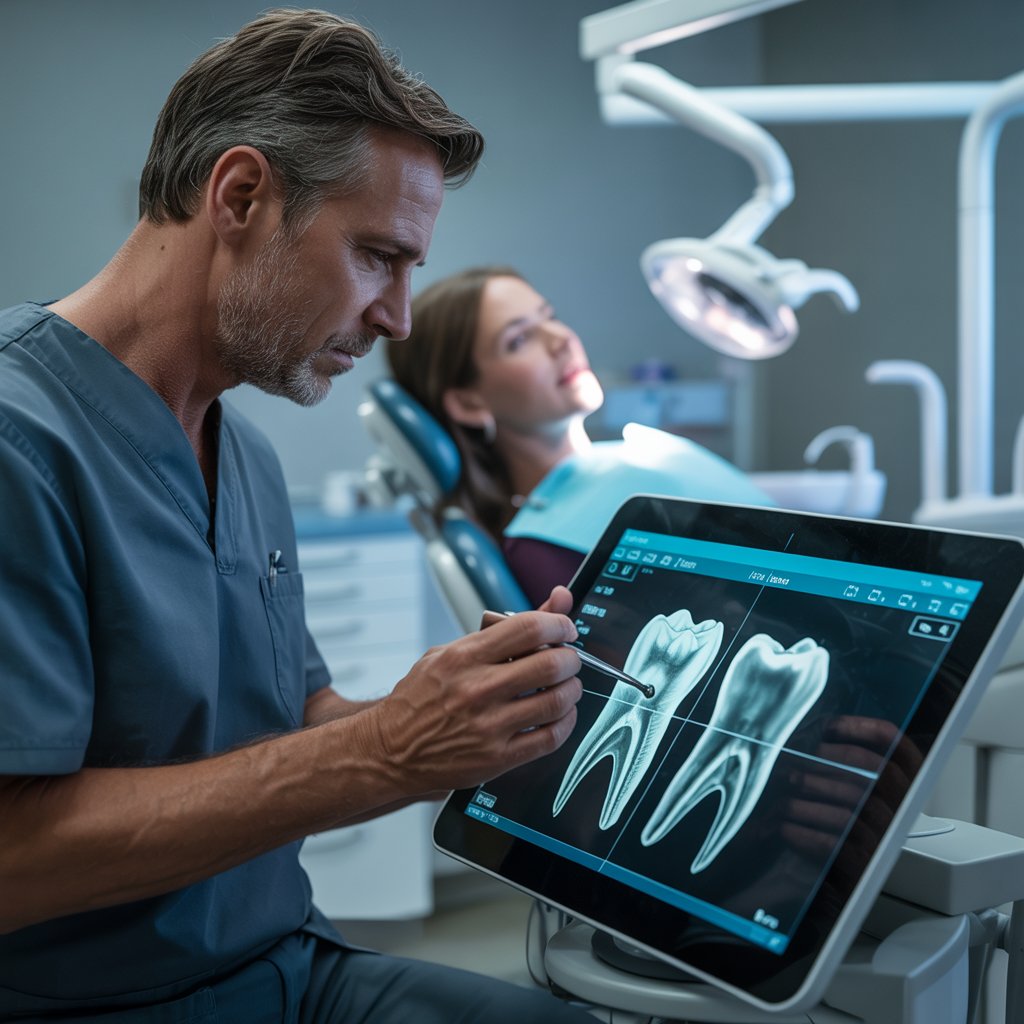
When you come in with a suspected dental infection, the exam is usually focused and efficient. The dentist wants to know when the pain started, whether temperature triggers it, whether swelling has changed quickly, and whether there has been drainage or fever. X-rays help identify decay, root infections, bone loss, or impacted teeth. Tapping, bite tests, and temperature tests may be used to pinpoint the culprit when several teeth feel suspicious.
The treatment depends on the source. If the tooth can be saved, root canal therapy is often the definitive solution because it removes the infected tissue inside the tooth and seals the canals. If the tooth is split, severely decayed below the gumline, or structurally hopeless, extraction may be the more predictable option. Gum and wisdom tooth infections may require cleaning, drainage, irrigation, or removal of the tooth once the acute inflammation is controlled.
Antibiotics have a role, but they are not the whole answer. That is a point patients sometimes find frustrating. If there is a sealed-off source of infection inside a tooth, medication alone may not eliminate it. It may reduce swelling for a while, but without treating the source, the infection often returns. Dentists have seen this pattern repeatedly: a brief improvement, a missed follow-up, then a worse flare several weeks later.
What you can do while waiting to be seen
If you are arranging an urgent appointment, simple measures can help reduce discomfort without masking the seriousness of the situation. Rinse gently with warm salt water if it is soothing. Keep your head elevated rather than lying flat. If over-the-counter pain relievers are safe for you medically, take them as directed on the label. Use a cold compress on the outside of the face for swelling.
Avoid placing aspirin directly on Emergency dentist Plano, TX the gum, which can burn tissue. Do not apply heat to the outside of the face, because it may worsen swelling. Do not try to lance the area yourself. That tends to create additional trauma and contamination, and it rarely drains the real source adequately.
If a filling or crown has broken off and the tooth is also painful or swollen, mention both when you call. Offices that handle emergency dentistry know the difference between a mechanical problem and an infectious one, and that affects scheduling urgency.
Why delay often makes treatment harder and more expensive
One uncomfortable truth about dental infections is that they rarely become cheaper with time. A small cavity may be repaired with a filling. Once the nerve becomes infected, you are usually looking at root canal treatment and a crown, or extraction and replacement planning. If swelling is substantial, care may need to happen in stages, with initial management first and definitive treatment after the acute phase settles.
There is also the matter of work, sleep, and daily functioning. Anyone who has spent a night with an abscessed molar knows how disabling it can be. People stop chewing on one side, miss meetings, cancel travel, and arrive at the office exhausted after pacing the floor all night. That cost does not show up on a treatment plan, but it is real.
In a city like Plano, where schedules are tight and family logistics are complex, it is common to see patients who hoped to “make it through the weekend” only to find themselves seeking emergency care Sunday morning with a swollen face. A faster call on Friday often would have changed the entire course.
The cases that fool people most often
Some of the most misleading infections are the ones that come and go. The tooth hurts badly for two days, settles down, then flares again a week later. Or a gum bump appears, drains, and disappears. People interpret the quiet periods as healing. In reality, intermittent symptoms often reflect an infection finding a temporary outlet, not a true resolution.
Another deceptive case is the upper back tooth that feels like sinus pressure. Upper molar infections can mimic sinus discomfort because of their proximity to the sinus floor. Patients describe pressure beneath the eye, tenderness when bending forward, or a vague ache in the cheek. If the tooth is also sensitive to biting or temperature, the source may be dental rather than nasal.
Lower molars can refer pain toward the ear or down the jawline. That leads some people to suspect an ear infection or temporomandibular joint problem. Referred pain is common enough that dentists do not rely on location alone. They look for the pattern, triggers, and tissue changes that tell the fuller story.
Knowing when to call an emergency dentist Plano, TX office
If you have severe, lingering tooth pain, noticeable swelling, fever, drainage, or trouble opening your mouth, it is time to call. If swallowing or breathing is changing, skip the wait and seek emergency medical attention. Most serious dental infections are manageable when treated promptly. The danger rises when the infection is allowed to spread unchecked.
Patients often worry that they are overreacting. In practice, it is far more common to see people who waited too long than people who came in too early. A skilled emergency dentist Plano, TX provider is not there to judge whether the pain is “bad enough.” Their job is to determine whether you have an infection, stop it from progressing, and protect the tooth if possible, or your health if the tooth cannot be saved.
The mouth does not leave much room for error once swelling begins. When the signs point toward infection, timing matters. Prompt evaluation can mean the difference between a contained problem and a much larger one.
Vitality Dental
1220 Coit Rd # 106, Plano, TX 75075, United States
+1 972-645-4100
FAQ About Emergency dentist Plano, TX
Will the ER do anything for dental pain?
An emergency department can assess urgent symptoms and provide medical stabilization. Definitive treatment of the tooth usually requires a dentist. Seek emergency medical care for breathing or swallowing difficulty, uncontrolled bleeding, or serious facial injury.
What to do if I have a dental emergency in the middle of the night?
Contact a dentist or after-hours dental service promptly for guidance. If a permanent tooth is knocked out, keep it moist in milk while seeking immediate care. If symptoms suggest a medical emergency, go to an emergency department.
What qualifies as a dental emergency?
A knocked-out permanent tooth, severe or persistent tooth pain, a significant dental injury, or swelling may require urgent dental assessment. Call a dentist to describe the symptoms and determine timing. Uncontrolled bleeding or difficulty breathing or swallowing requires emergency medical care.